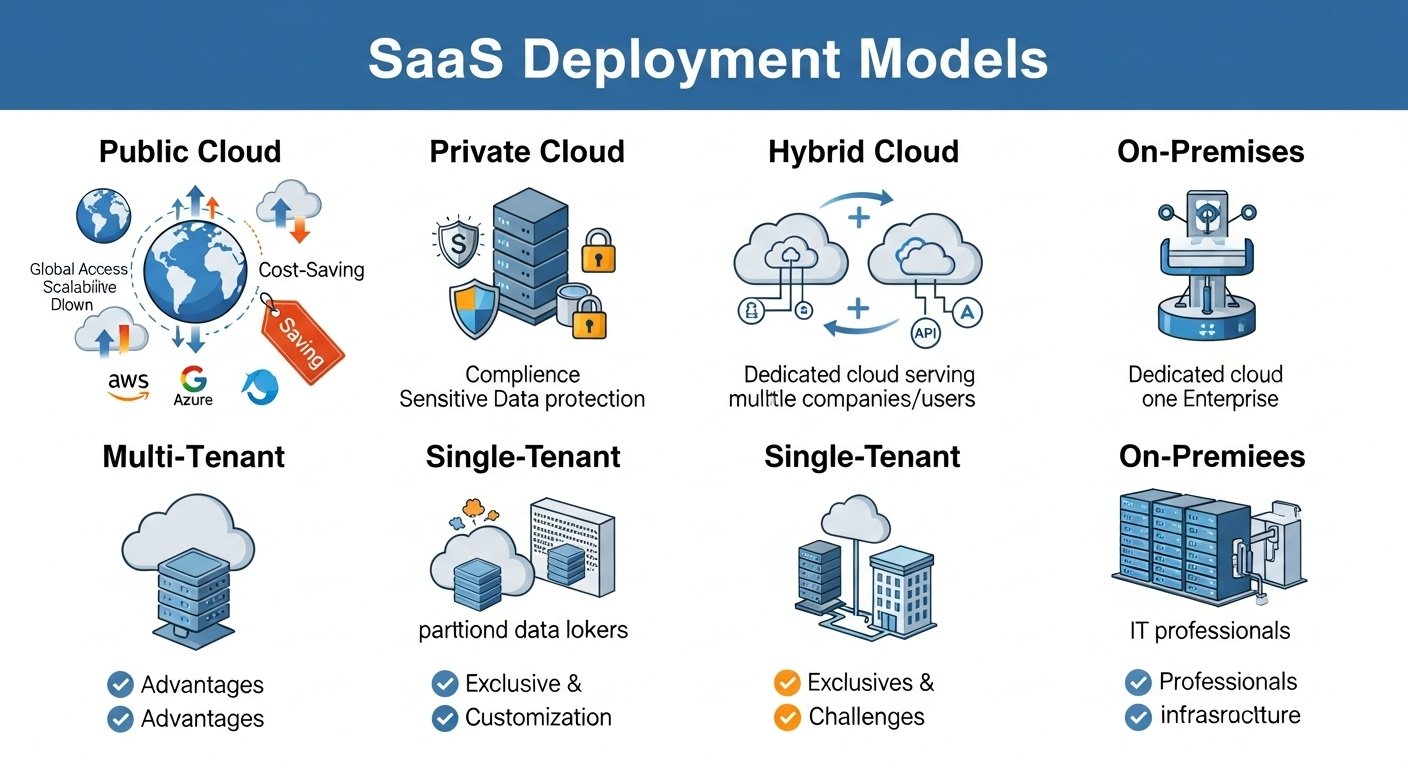
In today’s digital AI-based era, businesses and companies are rapidly and quickly adopting cloud-based solutions at a very fast pace, with their primary focus on scalability, security, and efficiency. This is where place SaaS deployment models plays a crucial, and sometimes challenging, role.
These models define how a software based application will be hosted, how it possibly will be delivered to users, and who will manage its infrastructure. Whenever an organization adopts SaaS, it must decide which deployment model is the best to fit. This decision has directly impacts on its cost structure, security compliance, and overall growth strategy.
The Importance of Choosing the Right Deployment Model
Every enterprise has a unique needs in modern era, and SaaS deployment models are probably designed to address those specific requirements. If a startup seeks low cost reaction and fast scalability, the public cloud or multi-tenant model would be the perfect choice.
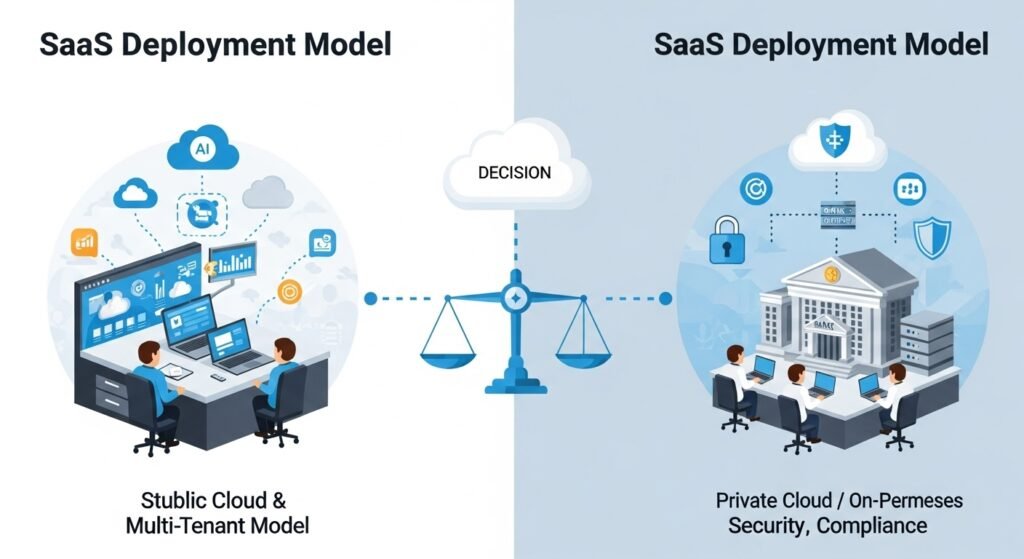
A private cloud or on-premises deployment is more appropriate, though, if a government agency or bank, whether public or private, requires stringent compliance and control. In the selection process Selecting the incorrect model may result in unneeded costs, security breaches, and operational difficulties. Therefore, before implementing a SaaS deployment model, organisations should carefully assess their long-term strategy, data sensitivity, and business size.
Single-Tenant based SaaS Deployment Model
When an enterprise and industry requires a dedicated environment mean additional environment, the single-tenant SaaS deployment model is used. In this automated setup, a separate instance is fully created for each customer according to requirement of customer, by enabling a high level of isolation and customization.
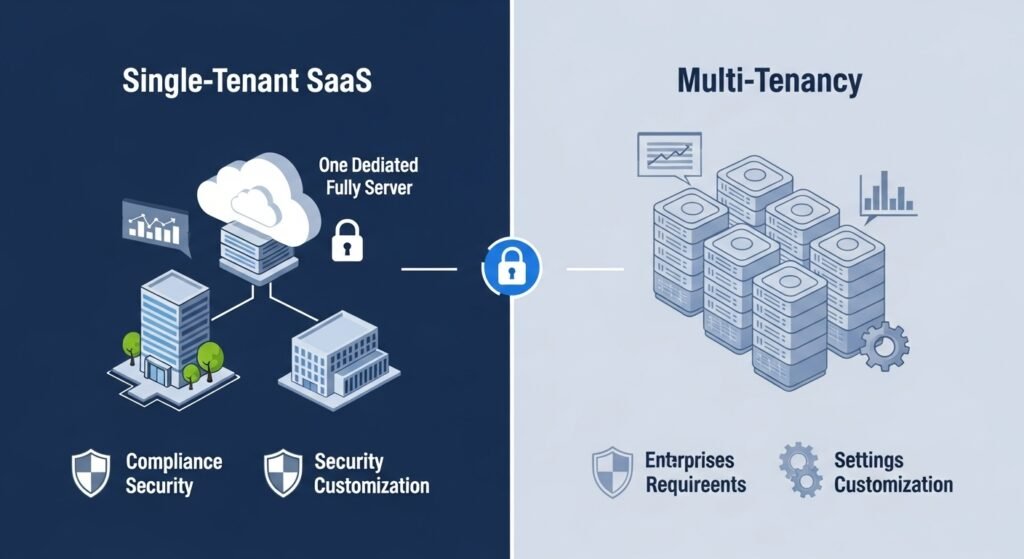
The vendor manages the instance, but the underlying infrastructure is dedicated to a single customer mean a one by one sequence. This model is very especially popular and highlighted among the large organizations and industries with strict compliance and performance requirements.
However, the drawback lies in its higher cost means peak and maintenance compared to multi-tenant models, since resources are not shared.
Public Cloud SaaS Deployment Model
The public cloud is one of the most widely means adopted SaaS deployment models, where applications run on infrastructures provided by AWS, Google Cloud, or Microsoft Azure. In this model, the vendor does not need to worry about maintaining related servers, allowing them to focus entirely on application features and user experience.
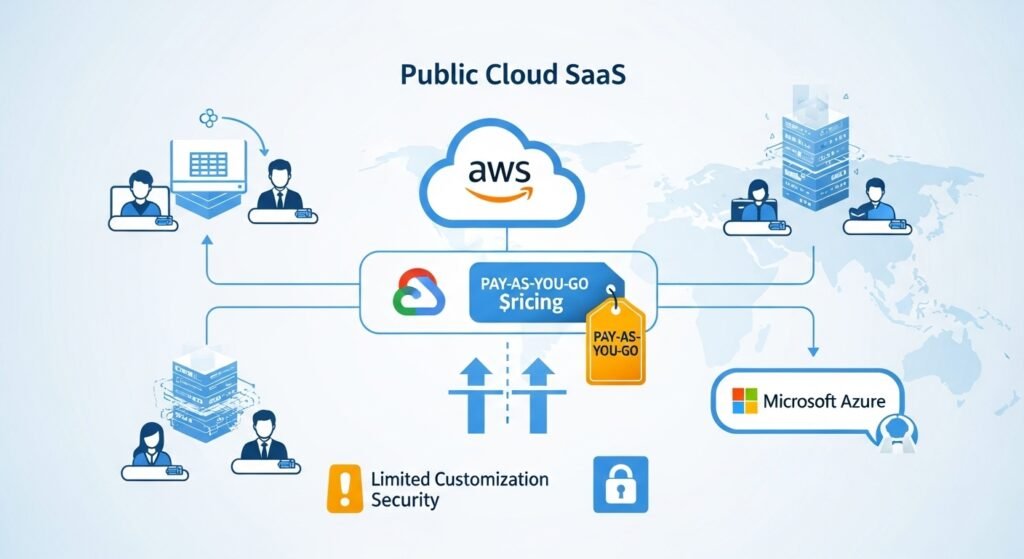
Public cloud follows a pay-as-you-go pricing model, making it highly cost-effective for startups and SMEs. Its biggest benefit is scalability, as applications can automatically scale up or down according to demand. However, the limitation lies in restricted customization and limited security controls since the infrastructure is shared.
Private Cloud SaaS Deployment Model
The private cloud is basically designed for organizations and industries that want complete control and facility of access over their data and infrastructure. In this model, the infrastructure is dedicated to a single organization, whether managed in-house, outdoor or through a trusted third party mean outdoor party.
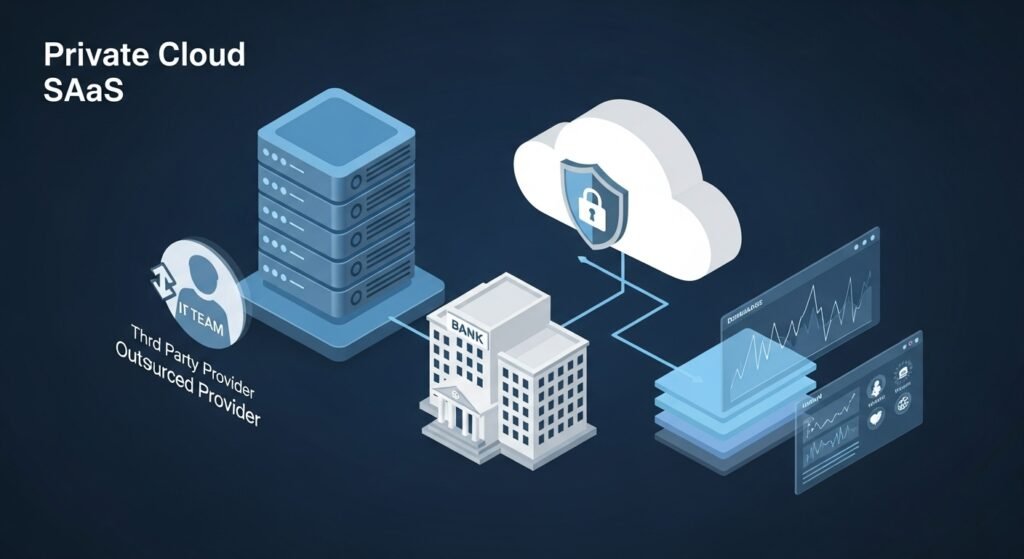
It is most suitable for all private and govt institutes like banks, healthcare institutions, and government agencies that handle sensitive data. Private cloud architectures totally rely on virtualization and orchestration tools to simplify resource allocation and monitoring. Although the relevenat cost and complexity of this model are higher, its working advantages in terms of security and compliance remain unmatched.
Hybrid Cloud SaaS Deployment Model
The hybrid cloud is a very balanced and stable approach in which both public and private cloud environments are combined means a combination of them to create a unified system. The primary purpose of this model is to provide flexibility and also allowing organisations to store sensitive workloads data in a private cloud while deploying non-sensitive components in the public cloud.
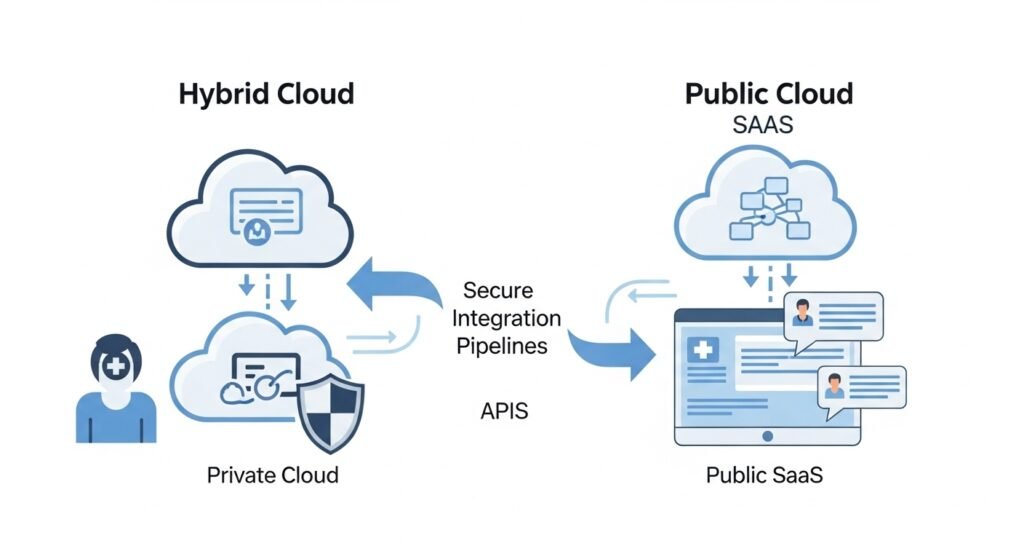
A healthcare provider or health worker that stores patient records in a private cloud but uses public SaaS for general communication serves as a perfect example. In hybrid cloud computing, APIs and integration tools are essential since they guarantee data synchronisation and seamless interoperability. Data governance and cost effectiveness continue to be major issues that companies must carefully weigh.
On-Premises SaaS Deployment Model
On-premises, or hosted SaaS (Software as a Service), has mostly become relatively rare, yet it still maintains significant demand among large enterprises and big working mean international level industries. In this model, the software is deployed on the organization’s own datacenter or servers.
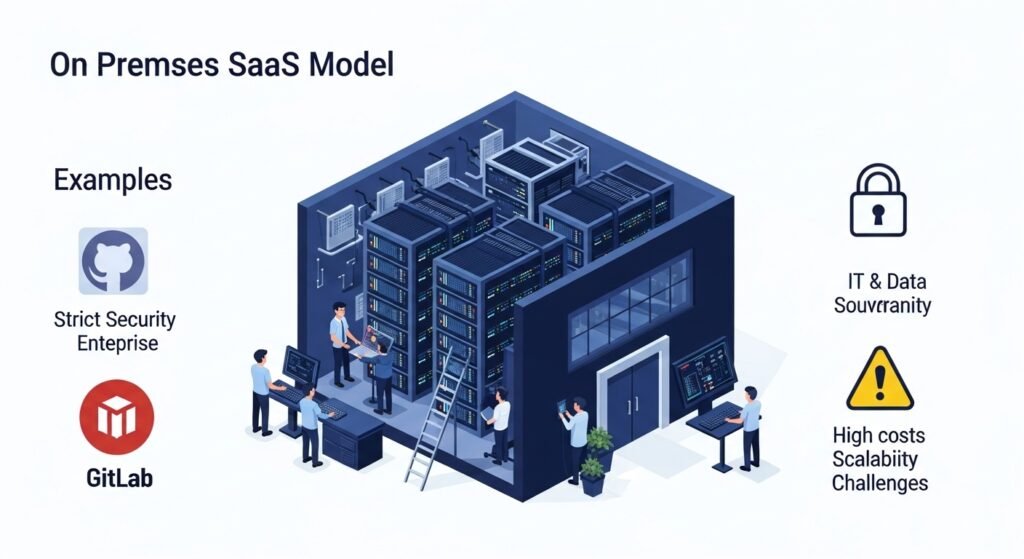
It allows complete control and deep customization, but its maintenance requirements and IT resource costs are considerably high. Real-world examples for understanding include GitHub Enterprise or self-hosted GitLab.
On-premises deployment is particularly very suitable for organizations unwilling to compromise on strictly based security policies and data sovereignty. Still, two of the most obstacles to long-term sustainability are high costs and scaling constraints.
Advantages and Challenges of Different Models
Every SaaS deployment model has different advantages but in this case it comes with numerous advantages and challenges that organizations must address. The public cloud is widely cost-effective and globally accessible, but its customization options are limited and facilitated.
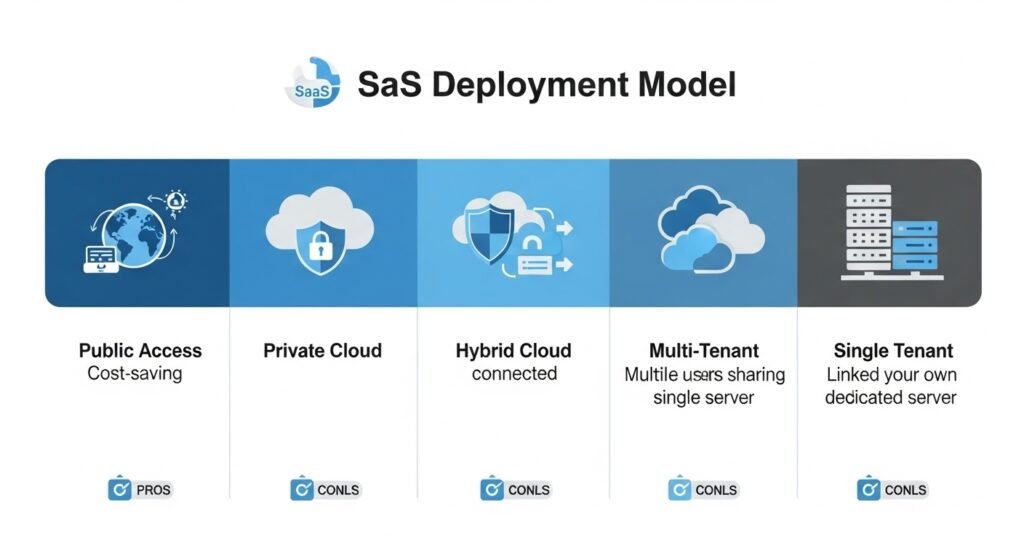
The private cloud offers unmatched security means no required additional security and compliance benefits, yet its cost and complexity are significantly higher. Hybrid cloud provides balance, though integration and data management remain difficult to handle.
Multi-tenant models allow means give access to easy adoption but often raise concerns around shadow IT. Although they provide dedicated mean additional environments, single-tenant based models require a lot of resources means working in large scale.
Conclusion: Choosing the Right SaaS Deployment Model
To sum up these, SaaS (Software as a Service) deployment models are the process of a company’s digital transformation process. ALL models like Public based , private, hybrid, on-premises, multi-tenant, and single-tenant models all provide a unique value proposition to meet distinct business needs. When choosing, one amoung them should always take into account the size of the company, compliance requirements, security issues, and budgetary limitations. Only when the deployment option selected is in perfect harmony with company goals can SaaS reach its full potential.