
We can understand the meaning of Enterprise SaaS as such a system that is cloud-based software solutions which are specifically designed for all large and small businesses so that ease can be created for them. According to GetStream, Enterprise SaaS is built to serve companies with many employees, typically over 1,000, offering the tools needed for large company operations via subscription rather than one-time purchase.
Stream Compared with traditional, that is old enterprise software, the difference is that it does not use the on-premise type installation method, but rather provides online access through a subscription model so the process is completed fastly, and the benefit of this is that updates and maintenance become easy. In today’s AI-based digital era, modern businesses are adopting it because it enables scalability, flexibility, and remote collaboration as well as other remote procedures. IBM points out that one of the key advantages of SaaS is “scalability and integration” and that it allows you to scale usage up or down without buying new hardware. IBM+1 Both small and large companies and both small and big businesses are using it to enhance productivity growth and for an effective increase in cost-effective solutions.
Key Characteristics of Enterprise SaaS
The key characteristics or facilities of Enterprise SaaS are clearly mentioned in its working design structure and functionality. The first, that is the process of multi-tenancy and scalability, which allows multiple users or persons and organizations to smoothly operate on the same platform so that the working is completed smoothly, and when the business grows it becomes possible to easily scale. Microsoft’s documentation describes several multitenant tenancy-patterns and how scaling can be done horizontally and vertically using Azure’s SaaS app designs. Microsoft Learn Also, Frontegg writes that multi-tenant architecture optimizes resource utilization, centralizes updates, and reduces cost while preserving isolation. Frontegg
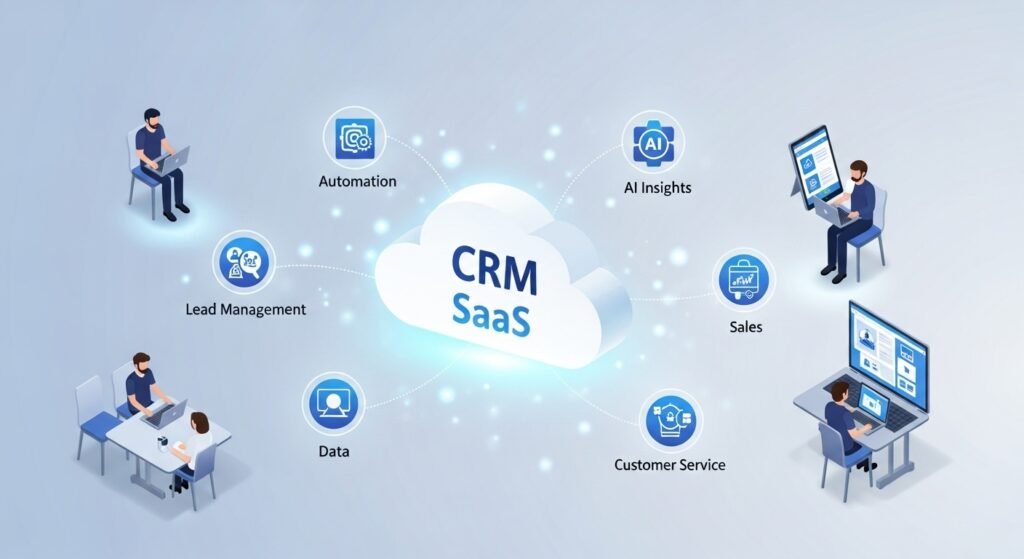
The second is the options of customization and configuration, through which companies can tailor the software for their specific workflows and processes and can add flow into their working. Security and data protection are very strong, including procedures like encryption and compliance standards. According to NordLayer, SaaS compliance involves encryption, access controls, and regular monitoring to protect data under regulations like GDPR, CCPA, or HIPAA.
nordlayer.com The SaaS Security Guide from Splunk also recommends audits covering data encryption, API security, and third-party integrations as essential security practices. Splunk . Along with this, it easily updates with other tools such as CRM, ERP, and productivity apps, ensuring seamless operations.
Enterprise SaaS vs. B2B SaaS
B2B SaaS meaning Business to Business Software as a Service is a broad category whose working process is that it provides cloud-based software for businesses which complete the process fastly. According to G2, B2B SaaS helps companies manage workflows like CRM, project management, and collaboration through scalable subscription-based platforms. (g2.com)
Whereas Enterprise SaaS meaning Enterprise Software as a Service works like its specific subset, which is specially designed for large, that is big and complex organizations. Salesforce explains that enterprise-level SaaS involves handling advanced requirements like global scalability, deeper integrations, and stronger compliance. (salesforce.com)
Enterprise SaaS caters to large firms, in which advanced scalability, tightly secured security, role-specific permissions, and deep integration capabilities are included, which are necessary for their high-complexity workflows. Gartner highlights that large enterprises demand higher availability, advanced analytics, and customizable architectures in SaaS adoption. (gartner.com)
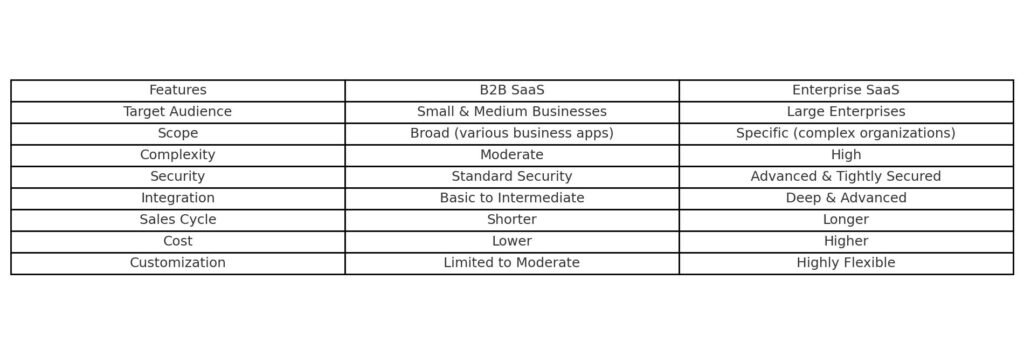
Its sales cycle is longer and the cost is also higher than B2B SaaS. Pricing models and payment terms are also flexible, so that enterprise-level customization and implementation can be done smoothly. Harvard Business Review also notes that enterprise SaaS requires long-term vendor relationships, deeper ROI assessments, and strategic scaling considerations. (hbr.org)
SaaS Benefits
SaaS is a cost-effective solution for businesses, individuals, and teams because the need for upfront hardware investment and licensing becomes very low. According to Inument, businesses can save a lot by avoiding upfront cost and instead paying for usage only. Inument Through web-based, that is digital access, work is possible from anywhere, from any place, which suits remote and hybrid teams or companies.

Vendors provide a highly scalable infrastructure, through which plans can be easily adjusted. Finoit explains that scalability allows organizations to grow or shrink resources based on demand. Finoit Technologies Data remains automatically backed up in clouds, by which a backup of it is created. Providers give a strong security system and compliance. Most SaaS providers implement encryption, regular security audits, and regulatory compliance (e.g. GDPR, HIPAA) to protect data.
iCoderz Solutions+1 Through APIs the process of compatibility and integrations becomes smooth. Finally, the outcome is that SaaS (Software as a Service) is user-friendly, onboarding is easy, and vendors handle updates and maintenance. This increases productivity and ROI.
Implementing Enterprise SaaS
Enterprise SaaS means to implement a type of Software as a Service, a clear planning process and phased rollout are necessary. First of all, rollout timeframes have to be defined so that smooth transition can be ensured. According to Gartner, phased rollouts reduce risks and help enterprises adopt SaaS effectively (gartner.com). Hidden requirements such as integrations and workflows must also be addressed, otherwise the adoption process can slow down. The multi-stage onboarding process with demos, training, and feedback loops helps users get familiar. Data security and compliance must be prioritized because enterprises handle large amounts of sensitive data. McKinsey highlights that addressing compliance early accelerates SaaS adoption (mckinsey.com). If the process is monitored and feedback included, implementation is successful and long-term adoption is guaranteed.
Measuring Success: KPIs for Enterprise SaaS
To measure success, tracking the right KPIs is critical. Key metrics include Lifetime Value (LTV), Customer Acquisition Cost (CAC), Monthly Recurring Revenue (MRR), churn rate, and retention rate. These indicators highlight marketing efficiency, revenue stability, and customer loyalty. As ProfitWell explains, measuring LTV/CAC ratio and MRR trends ensures SaaS growth strategies stay effective (profitwell.com). By combining these KPIs, businesses can analyze adoption, ROI, and future needs. Insights from metrics refine strategies, such as optimizing pricing, improving onboarding, and enhancing customer satisfaction—making long-term growth sustainable.
Conclusion: Enterprise SaaS Driving Digital Transformation
In today’s digital era, Enterprise SaaS has become a core driver that provides enterprises agility, scalability, and smarter operations. This is not only a software model but a digital transformation engine that automates workflows, connects teams, and accelerates innovation. Industry experts note that SaaS adoption is central to achieving enterprise-wide agility and innovation at scale (forrester.com).